Annual report 2003-2004
Annual report 2003-2004
Message from the Chief Commissioner
June 2004
I am pleased to report on the work of the Ontario Human Rights Commission for the April 1, 2003 to March 31, 2004 fiscal year.
This year, the Commission opened 2,450 cases and closed 2,038 cases. The active caseload on March 31, 2004 was 2,549 cases. The average age of the Commission’s active caseload was 10.8 months, which indicates that the Commission continues to maintain a caseload that is 12 months or less. The Commission referred a record 288 human rights complaints to the Human Rights Tribunal of Ontario.
During 2003-2004, the Commission accomplished several key achievements. Most notably, the Commission:
- conducted an inquiry into the effects of racial profiling on individuals, their families and communities, and released its report on the inquiry entitled, Paying the Price: the Human Cost of Racial Profiling;
- released a consultation report on disability and access to education services entitled, The Opportunity to Succeed: Achieving Barrier-free Education for Students with Disabilities;
- launched a public education awareness campaign to address age discrimination in partnership with Shoppers Drug Mart and CARP, the Canadian Association for the Fifty-Plus;
- referred 200 autism-related complaints to the Human Rights Tribunal of Ontario; and,
- secured commitments from seven restaurant chains following the Commission’s report, Dining Out Accessibly.
Finally, I am grateful to staff for their continued hard work, which has enabled the Commission to meet a number of challenges during the past year.
Keith C. Norton Q.C., B.A., LL.B
Chief Commissioner
The Ontario Human Rights Commission (the “Commission”) is an arm’s length agency of the government, accountable to the Legislature of Ontario through the Attorney General. The Commission’s principal functions are set out in the Ontario Human Rights Code (the “Code”) and include the promotion and advancement of human rights and the investigation, mediation, settlement and litigation of complaints.
Caseload management
Caseload management
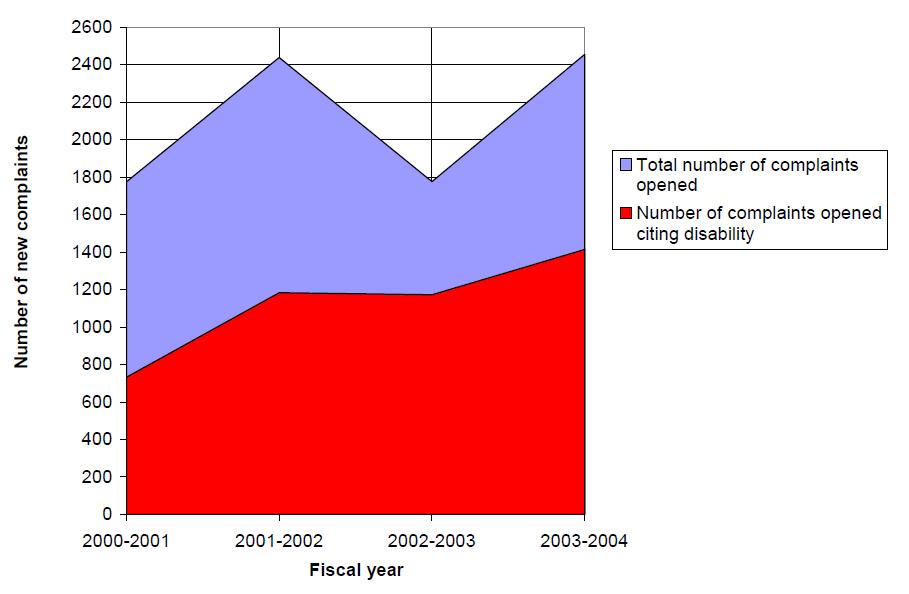
Under the Code, the Commission is required to receive all complaints that fall within its jurisdiction. In the fiscal year 2003-2004, 2,450 new complaints were filed at the Commission. This amounts to an increase of 674 cases (or 38%) over complaints filed in the 2002-2003 fiscal period and represents a general rise in complaints across most grounds of discrimination. Until this past year, new complaints filed generally remained below 2,000 cases per year. During the same period, the Commission closed 2,038 complaints.
Inquiry and Intake
In 2003-2004, the Commission’s Inquiry and Intake office received 2,275 written inquiries, attended to 843 visitors to the office and responded to 42,650 of the 67,216 telephone calls it received.
Staff sent out 4,847 intake packages, and received 2,709 completed intake packages in return.
Mediation
The Commission’s Mediation Office offers both formal and informal mediation services to parties. During 2003-2004, the Mediation Office closed 1,104 cases, and the mediation settlement rate was 71%.
Investigation
The Commission’s Investigation Office conducts investigation and conciliation of complaints that are not settled or otherwise resolved through the Mediation Office. In this fiscal year, the total number of cases closed through investigation was 934.
The Caseload
On March 31, 2004, the Commission’s active caseload was 2,549 cases. This represents an increase of 412 cases over last year’s caseload of 2,137.
Despite an increase in the number of complaints filed, the Commission closed 2,038 cases compared to the 1,954 complaints closed last year, and continued to reduce the average age of the Commission’s active caseload from 11.5 months to 10.8 months.
The Commission also referred a record 288 cases to the Human Rights Tribunal of Ontario (200 of which are being heard together). Last year, 58 referrals were made.
Policy development
Policy development
In keeping with its mandate to promote understanding of human rights and to conduct research to eliminate discriminatory practices, the Commission undertook a number of policy development initiatives in 2003-2004. Commission policies and guidelines are approved public statements that set out the Commission’s interpretation of the Code.
Racial Profiling
During the year 2003-2004, the Commission completed its inquiry into the effects of racial profiling on communities. The purpose of the inquiry was twofold: to give a voice to individuals who have experienced profiling and, in doing so, raise awareness of the negative consequences of profiling among people who have not been impacted by it.
On December 9, 2003, the Commission released its final Report on the inquiry entitled Paying the Price: the Human Cost of Racial Profiling. The Report looks at the impact of racial profiling on individuals who have experienced it, their families and their communities, and the detrimental effects of this practice on society as a whole.
The Report provides recommendations aimed at ending the practice of profiling where it already exists, improving the monitoring of situations where it is alleged to occur, and preventing incidents of profiling from occurring in the first place. The Report received major media coverage, and on the whole, elicited favourable reaction from the public. Information generated during the inquiry will also be used to inform the Commission’s work towards policy development on the ground of race.
Disability and Education
In October 2003, the Commission released a Consultation Report entitled The Opportunity to Succeed: Achieving Barrier-free Education for Students with Disabilities.
The Report represents an overview of the feedback received from consultees from across the province during the Commission’s consultation in the fall of 2002. It canvasses human rights issues that arise in the provision of education to students with disabilities at the primary, secondary and post-secondary levels, outlines actions required by parties to the accommodation process and sets out the Commission’s own commitments in this regard.
The Commission is currently developing Guidelines on Accessible Education as a companion document to the Consultation Report. The Guidelines will outline the Commission’s interpretation of the legal responsibilities of all parties to the accommodation process with respect to: access to education, combating negative attitudes and stereotypes, determining and providing appropriate accommodations, respecting the confidentiality of persons with disabilities, developing a dignified and effective accommodation process, and applying the undue hardship standard.
Aboriginal Human Rights Program
Throughout the 2003-2004 year, the Commission continued its partnership with the Native Canadian Centre of Toronto in conducting the Aboriginal Human Rights Program. The objectives of this program, now in its fourth year of operation, are to create and build on awareness of the Code among people of Aboriginal communities and to enhance their access to the Commission’s services. A human rights coordinator was engaged to provide information and support to individuals experiencing discrimination and assist them with access to the Commission’s complaint process, if required. Three public education activities per month were held in workplaces, schools and community agencies. The Commission will be consulting with community representatives to develop some options for building on what has been learned through the program to date.
Restaurant Accessibility Initiative
In June 2003, the results of an independent accessibility audit of seven restaurant chains prepared for the Commission were shared with Country Style Donuts, McDonalds, Pizza Hut, Starbucks, Subway, Swiss Chalet and Tim Hortons.
The audit of four sites per chain demonstrated the nature of barriers that customers with disabilities would face. These included lack of safe pedestrian routes into the restaurant, automatic doors at entrances, lower counter heights at cash registers or self-serve areas, Braille menus, and accessible washroom facilities.
The Commission believes that rather than addressing barriers on the basis of one human rights complaint at a time, it is far more preferable that businesses make commitments and take steps to achieve inclusive facilities voluntarily and cooperatively.
During the fall, the Chief Commissioner met with representatives from the chains and found their willingness to cooperate and discuss concerns to be very positive. All seven chains made commitments to a process that will eliminate barriers for customers with disabilities.
The Commission’s report on this initiative entitled, Dining Out Accessibly is scheduled for release in April 2004. The Commission plans to seek similar cooperation and commitments from others in the restaurant and hospitality industry.
Advice on human rights matters
Advice on human rights matters
As part of its mandate to eliminate discrimination in society and advance broader societal and human rights issues as they emerge, the Commission provided advice on a number of matters.
Mandatory Retirement
The Chief Commissioner issued a press release in May 2003 regarding the introduction of a Bill that would provide more flexibility and choice in the area of retirement. He also wrote to the new government in January 2004, encouraging them to reintroduce legislation that will eliminate the requirement for workers to retire at age 65 and provide them with human rights protections in the workplace.
ODA Submission
In March 2004, the Commission presented an in-depth submission to the Ministry of Citizenship and Immigration, outlining the need for reform to the Ontarians with Disabilities Act. The steady increase in recent years of complaints by persons with disabilities to the OHRC illustrates the importance of making the Ontarians with Disabilities Act an agent of real change for persons with disabilities in this province.
The submission describes priorities for change as well as the human rights principles that should be reflected in a revised Ontarians with Disabilities Act.
The Commission believes that, in order to be effective, the Ontarians with Disabilities Act must apply to the private as well as the public sector, build on the protections of the Code and accepted human rights principles, and address more precisely the issues of persons with non-mobility related disabilities. Accessibility plans should be retained and refined as essential tools for achieving a barrier-free Ontario, and accessibility standards should be developed and applied. Measures for receiving and resolving complaints are also essential, as are monitoring, public reporting and accountability measures for the body charged with administering and enforcing the Ontarians with Disabilities Act.
Accessible Public Transit
In keeping with its stated commitment to promote accessible public transit, the Commission, working with the Ontario Community Transportation Association (OCTA), discussed accessibility issues as part of a panel at the Ontario Transportation Expo Annual Conference in April 2003.
Commission staff also participated in OCTA’s four regional meetings held in October 2003 with over 40 transit authorities across the province. As well, in its March 2004 submission on the Ontarians With Disabilities Act, the Commission identified public transit as one of several key sectors where a sustained collaborative approach and standards setting are needed to bring about progressive realization of rights.
Other Matters
The Commission also wrote to:
- the Minister of Health and Long-Term Care and the Association of Municipalities of Ontario about the possible adverse effects of the Ministry’s proposed strategy of using chemical agents to deal with the West Nile Virus on persons protected by the Code, including pregnant women, young children and persons with disabilities, in particular, persons with environmental sensitivities;
- the major providers of gas station services, outlining their responsibilities under the Code to provide equal and appropriate service to persons with disabilities;
- the Minister of Children's Services and the Minister of Education regarding access to preschool programs for deaf/hard of hearing children;
- the Psychiatric Patient Advocate Office in response to two concerns raised about the rights of persons with mental illness: the search and seizure of personal property of patients living in psychiatric facilities; and, the Coroners Act stipulation that inquests for deaths of persons involuntarily committed to psychiatric facilities are discretionary; and,
- the Minister of Community Safety and Correctional Services outlining that, when undertaken appropriately, race-based data collection can be an effective component of a broad strategy for preventing social phenomena widely recognized as discriminatory, such as racial profiling. The Commission plans to release guidelines on data collection early in the 2004-2005 fiscal year.
Increasing awareness through public education and partnerships
Increasing awareness through public education and partnerships
Another important function of the Commission is to develop and conduct programs of public information and education.
During the 2003-2004 fiscal year, the Commission participated in a total of 105 public education events to community groups, employer groups, law offices and educators reaching nearly 9,000 individuals. Presentations covered a variety of topics ranging from workplace harassment and accommodation for persons with disabilities in educational settings to racial profiling and accessibility of public transit. The Chief Commissioner also spoke with educational groups, including elementary and secondary school students, and teacher and postsecondary faculties, at conferences organized by law offices and legal clinics, and met with visiting international delegations. And, many more individuals are reached through other initiatives, such as the Commission’s public awareness campaigns.
Shoppers Drug Mart and CARP – Age poster campaign
In July 2003, the Commission launched a public awareness campaign to counteract myths and stereotypes about older persons, in partnership with Shoppers Drug Mart and CARP, Canada’s Association for the Fifty-Plus. For a two-week period from July 26th to August 9th, 2003, Shoppers Drug Mart stores across the country displayed the Commission’s Best Before posters of older persons with the tagline, "Nobody has a shelf life. Stop age discrimination now. It's illegal, and it's just plain wrong." The drugstores also distributed a new leaflet on age discrimination to develop a better understanding by the public of ageism and its effects.
HRPAO – Revised Human Rights at Work publication
In February 2004, the Commission, in partnership with the Human Resources Professionals Association of Ontario (HRPAO) launched a revised and expanded version of Human Rights at Work. This plain language guide for employers is one of the Commission's most popular publications and covers the key human rights issues in today’s workplaces: job design and hiring, accommodating persons with disabilities, drug and alcohol testing, harassment policies and rights for pregnant employees and same-sex partners.
www.ohrc.on.ca
The Commission’s Web site provides quick access to Commission policies, plain language guides, and to case summaries, news releases and information on consultations and upcoming initiatives.
During the fiscal year 2003-2004, 461,365 unique visits to the Web site were recorded, which represents an increase of more than 130,000 unique visits over the previous fiscal year. On average 1,261 people visited the Web site each day.
International Human Rights Instruments
The Commission also provides input into Canada’s reports, which are required under the various international human rights instruments to which Canada is a signatory.
In 2003-2004, the Commission provided information for Ontario’s submission for Canada’s 5th Report on the International Covenant on Civil and Political Rights, and submitted a response to the draft United Nations Human Rights Report on Canada (released in February 2004) following the Chief Commissioner’s meeting in September 2003 with M. Doudou Diene, the U.N. Special Rapporteur on Contemporary Forms of Racism.
Legal services branch
Legal services branch
During the 2003-2004 fiscal year, the Legal Services Branch was involved in the following resolutions: 7 Human Rights Tribunal of Ontario decisions, 26 settlements, 5 judicial review decisions, 3 decisions from the Superior Court of Justice, 5 appeal court decisions, and 2 decisions from the Supreme Court of Canada.
At the end of the 2003-2004 fiscal year, the ongoing litigation in the Legal Services Branch comprised of: 292 complaints before the Human Rights Tribunal of Ontario (200 of these cases are being heard together), 12 judicial review applications before the Divisional Court, 2 cases before the Superior Court of Justice, 5 appeals before various Ontario Courts (including an intervention in the Court of Appeal), and 5 cases at the Supreme Court of Canada.
The following are highlights of some of the significant decisions, settlements, and cases over the past year.
Case Summary Highlights
1. Parry Sound (District) Social Services Administration Board v. Ontario Public Service Employees Union, Local 324 (S.C.C.)
The Supreme Court of Canada ruled that a grievance arbitrator has the power and responsibility to enforce the substantive rights and obligations of human rights and other employment-related statutes as if they were part of the collective agreement. The Court stated that human rights and employment standards legislation set a standard below which an employer and union cannot contract. The Court therefore held that the Board of Arbitration was correct to conclude that the substantive rights and obligations of the Human Rights Code are incorporated into each collective agreement over which an arbitrator has jurisdiction. Accordingly, the Supreme Court found no reason to interfere with the Board’s finding that the subject matter of the grievance was arbitrable.
2. Pritchard v. Ontario Human Rights Commission (S.C.C.)
The Court upheld the Commission’s claim that a legal opinion provided to the Commissioners is subject to solicitor-client privilege and need not be disclosed to the parties to the complaint. Solicitor-client privilege applies with equal force in the context of advice given to an administrative board by in-house counsel as it does to advice given in the realm of private law.
The "common interest" or "joint interest" exception to solicitor-client privilege does not apply to the Commission because it does not share an interest with the parties before it. The Commission is a disinterested gatekeeper for human rights complaints and, by definition, does not have a stake in the outcome of any claim. The Commission neither has a trust relationship with, nor owes a fiduciary duty to, the parties appearing before it. Procedural fairness also does not require the disclosure of a privileged legal opinion.
Section 10 of the Judicial Review Procedure Act does not clearly or unequivocally express an intention to abrogate solicitor-client privilege, nor does it stipulate that the "record" includes legal opinions. As such, "record of the proceedings" should not be read to include privileged communications from Commission counsel to the Commission.
3. Canada Mortgage and Housing Corp. v. Iness (Ont. Court of Appeal)
The Court of Appeal held that the eligibility criteria attached to a federal government housing grant (here, between the Canada Mortgage and Housing Corp. (CMHC) and Caroline Co-Operative Homes Inc.) was not subject to provincial human rights legislation.
The complainant alleged that one of the criteria under which she received a housing subsidy discriminated against her as a person in receipt of social assistance. After referral of the complaint to the Human Rights Tribunal of Ontario, the complainant successfully added CMHC as a respondent in the proceedings on the basis that CMHC’s funding policy and Operating Agreement were subject to provincial regulatory authority under the Code. On judicial review, however, the Divisional Court quashed the Tribunal’s order. The Court of Appeal, in dismissing the appeal, concluded that CMHC’s authority to advance funds to the Co-op was a valid exercise of the federal government’s “spending power” and was not an attempt to regulate a matter within provincial jurisdiction. The Court also agreed with the Divisional Court that, by virtue of the doctrine of interjurisdictional immunity, the Code must be read down so as not to limit the authority given to CMHC by valid federal legislation since the terms on which CMHC disburses federal funds are part of its core function.
The complainant is seeking leave to appeal to the Supreme Court of Canada.
4. Her Majesty the Queen in Right of Ontario v. Michael McKinnon and Ontario Human Rights Commission (Ont. Div. Ct.)
The Ministry of Correctional Services appealed from a decision of the Board of Inquiry (now Human Rights Tribunal of Ontario), dated November 29, 2002, which held that the Ministry failed to comply fully with a 1998 order of the same Board relating to discrimination in the workplace. The Board made further remedial orders in its decision which were the subject of this appeal. The Court held that there was sufficient evidence before the Board to support the finding that the Ministry did not comply with its previous order. The Court then had to consider whether having found non-compliance, the Board’s role was at an end, requiring the complainant to return to the Commission to begin anew with a fresh complaint. The Court held that this would be contrary to the intent of the Code, the purpose of which is to eradicate discrimination. The Court held that it was open to the Board, as part of its ongoing obligation to oversee implementation, to recast its original orders to meet what it found to be a continuing problem. Leave has been granted to the Ministry to bring a further appeal of the Board’s decision to the Ontario Court of Appeal.
5. Gismondi v. Ontario Human Rights Commission (Ont. Div. Ct.)
This was a judicial review of the Commission’s decision to exercise its discretion under s. 34 and s. 37 of the Code to not deal with Mr. Gismondi’s human rights complaint. The Commission’s reasons for not dealing with the complaint were that the complaint was filed too late and that this delay was not incurred in good faith. The Court considered the standard of review to be applied on a judicial review of the exercise of the Commission’s discretion under sections 34 and 37 of the Code. Given the Commission’s acknowledged expertise in dealing with human rights complaints, the purpose of the legislation and the nature of the particular problem being addressed by the Court on a review of a section 34 or 37 decision, the Court concluded that the Commission’s decisions in such matters are entitled to the degree of deference found at the “patent unreasonableness” end of the spectrum of review. The Court went on to find that the decisions of the Commission were not patently unreasonable in this case. In addition, the Court held that the Commission met all the requirements of procedural fairness.
6. Baylis-Flannery v. Walter DeWilde c.o.b. as Tri Community Physiotherapy (No. 2) (H.R.T.O.)
The Human Rights Tribunal of Ontario ruled that the respondent discriminated against the complainant because of her race and sex, sexually and racially harassed her, made sexual advances, and ultimately terminated her employment because she objected to his conduct. This decision represents the first time the Tribunal explicitly recognized and applied the concept of intersectionality with respect to both liability and remedy. The Tribunal found that the intersectionality of the discrimination based on sex and race exacerbated the complainant’s mental anguish. The Tribunal found that the respondent sexually and racially harassed the complainant because she was a young black woman over whom he could assert economic power and control. He also repeatedly diminished her because of his racist assumptions about the sexual promiscuity of black women. The Tribunal awarded the complainant $25,000 in general damages for sex discrimination, sexual solicitation and harassment, and reprisal, and $10,000 in general damages for racial discrimination and racial harassment. The Tribunal also awarded $10,000 for mental anguish and $3,384 for lost wages. In addition, the Tribunal also ordered the respondent to fulfill a series of public interest remedies.
Accountability framework
Accountability framework
The Commission’s Accountability Framework establishes targets for the organization’s performance in the coming year and reports on achievements against previously-established targets.
The following is a summary of achievements against targets in the 2003-2004 fiscal year.
|
SERVICE AREA |
2003-2004 COMMITMENTS |
|
Enforcement |
|
|
Promotion |
|
|
Advancement |
|
|
SERVICE AREA |
2003-2004 ACHIEVEMENTS |
|
|
Enforcement
|
|
|
|
Promotion
|
|
|
|
Advancement
|
|
|
The following are the Commission’s public commitments for the 2004-2005 fiscal year.
| SERVICE AREA | 2004-2005 COMMITMENTS |
| Enforcement |
|
| Promotion |
|
| Advancement |
|
Human Rights Tribunal of Ontario decisions & settlements
Human Rights Tribunal of Ontario decisions & settlements
|
Decisions |
Grounds |
|---|---|
|
St. Hill v. VRM Investments Ltd., et al. |
family status |
|
Weiher v. Polhill |
disability |
|
Morrison, Anton, Vapiwalla, McLean, Duhaney v. Motsewetsho and Patrons Online |
sex, sexual harassment, sexual solicitation, ethnic origin, reprisal |
|
Gibbons and Ladouceur v. Sports Medic Inc., et al |
sex, sexual harassment, solicitation |
|
Cunanan v. Boolean Developments Ltd., et al. |
family status, age, association |
|
Baylis-Flannery v. De Wild, Tri Community Physiotherapy |
sex, sexual solicitation, harassment, race, sexual harassment, reprisal |
|
Settlements |
Grounds |
|---|---|
|
Opeitum v. Cancer Care Ontario et al. |
race, colour, sex, reprisal, harassment |
|
Mohammed-Ali v. Skylink Technologies Inc., et al. |
creed, race, ethnic origin, reprisal |
|
Burga v. Airline Services International Inc.,Et al. |
sex |
|
Lewis v. Neurosurgery Associates et al. |
disability |
|
Lawson v. U of T et al. |
creed, citizenship, reprisal |
|
Negin v. The Equitable Trust Company et al. |
family status |
|
Powers v. Iskar Tools Inc., et al. |
disability |
|
Borden v. Penwest Development Corp. Ltd. o/a Bond Place Hotel et al. |
sex |
|
Crawley v. Anne Marie Hill Housing Co-Operative Inc. |
family status, sex, receipt of public assistance |
|
Defina v. Canadian Thermo Windows Inc., et al. |
disability |
|
DiRoma v. D.K.M. Manufacturing Ltd., et al |
age, sex, ethnic origin |
|
Han v. 922312 Ontario Ltd. o/a Steam Sauna et al. |
sex, sexual solicitation |
|
Da Costa v. Lovat Tunnel Equipment Inc., et al. |
race, colour, ancestry, place of origin, ethnic origin, reprisal |
|
Stephenson v. City of Toronto |
disability |
|
Jansen v. Syncromesh Inc., et al. |
disability |
|
Onoriode v. Woodbine building Supply Ltd., et al. |
race, colour, place of origin |
|
Livingstone v. Club Monaco Corp., et al. |
family status, reprisal |
|
Jane Doe v. An Ontario School Board et al. |
disability |
|
Stratton v. Skylink Technologies Inc. |
sex, sexual harassment, reprisal |
|
Mulligan v. Multiview Inc., et al. |
sex, reprisal, sexual harassment |
|
Ollson v. Wooden Dreams Ltd., et al. |
disability |
|
Lohnert v. Mother Parker’s Tea & Coffee |
disability |
|
Basdeo v. Travel Media Ltd., et al |
sex, sexual solicitation |
|
Piche v. Cornwall Youth Residence Inc., et al. |
sex |
|
Bishop v. Royal Canadian Legion (Talbot Trail Branch 613) et al. |
sex |
|
MacPherson v. Southern Supplies Ltd., et al. |
disability |
|
Epstein v. York Condo Corp. 67 et al. |
creed |
|
Geminiuc v. DMR Financial Services Group Inc., et al. |
contracts |
|
Cousineau v. Rainbow District School Board |
disability |
|
Ellery v. Orion Bus Industries Ltd. et al. |
disability, reprisal |
|
Reid, Mason v. Silex Inc. et al. |
race, colour, ancestry, place of origin, ethnic origin |
|
Armstrong v. City Buick Pontiac Cadillac Ltd. et al. |
race, colour, reprisal |
|
Cooper v. Beech Hall Housing Cooperative Inc.
|
disability, receipt of public assistance |
|
Somerville v. Pickerel Lake Lodge Ltd. et al. |
family status |
|
Roach v. Days Inn et al. |
ancestry |
|
Saxon v. Corporation of the Town of Amherstburg |
disability |
Superior Court of Justice Divisional Court (Judicial Review)
|
Campbell v. OHRC |
race, colour, ancestry, ethnic origin, place of origin, disability |
|
Cespedes v. University of Toronto and OHRC |
race, colour, ancestry, ethnic origin |
|
Chol v. York University and OHRC |
ancestry, colour, place of origin, race |
|
Gismondi v. Corporation of the City of Toronto and OHRC |
age |
|
Gurofsky v. Fanshaw College and OHRC |
disability |
|
Layzell v. OHRC |
sex, harassment, disability, reprisal |
|
O.N., A Minor by his litigation guardian, N.N., A Minor by his litigation guardian, and C.K. v. OHRC |
disability |
|
Mianowski v. OHRC and Lever Ponds |
disability |
|
Okafor v. Her Majesty the Queen and OHRC |
marital status, race, colour, family status, ethnic origin, creed, disability |
|
Pieters v. University of Toronto and OHRC |
race |
|
Pritchard v. OHRC |
sex, sexual harassment, reprisal |
|
Sleiman v. OHRC and AG of Ontario |
sex, family status, marital status |
|
Way v. Dufferin Peel Catholic District School Board et al. and OHRC |
marital status, age |
Superior Court of Justice (Civil)
|
Farris v. Staubach Ontario Inc. and OHRC |
sexual harassment |
|
Lacasse v.OHRC et al. |
ancestry |
Superior Court of Justice
Divisional Court
(Appeal)
|
Ministry of Correctional Services et al. v. Michael McKinnon and OHRC |
race, ancestry, ethnic origin, harassment |
Court of Appeal for Ontario
|
Brillinger v. The Canadian Lesbian and Gay Archives.and OHRC |
sexual orientation |
|
Iness v. Caroline Co-operative Housing Inc. et al. and OHRC |
receipt of public assistance |
|
Pieters v. University of Toronto and OHRC |
race |
Supreme Court of Canada
|
Parry Sound (District) Social Services Administration Board v. OPS et al. and OHRC |
sex |
|
Pritchard v. OHRC |
sex, sexual harassment, reprisal |
Tables
Tables
Table 1: New Complaints Filed by Social Area and Grounds Cited
Total Number of New Complaints: 2,450
| Accommodation | 7 | 2 | 10 | 0 | 1 | 4 | 48 | 13 | 11 | 6 | 11 | 11 | 29 | 0 | 4 | 10 | 5 | 8 | 180 | 90 | 3.67% |
| Contracts | 34 | 1 | 1 | 0 | 0 | 1 | 36 | 2 | 0 | 0 | 1 | 0 | 3 | 0 | 1 | 1 | 1 | 0 | 82 | 40 | 1.63% |
| Employment | 171 | 107 | 25 | 8 | 11 | 74 | 1090 | 223 | 90 | 45 | 183 | 0 | 502 | 1 | 240 | 586 | 229 | 77 | 3662 | 1940 | 79.18% |
| Services | 12 | 37 | 16 | 1 | 5 | 18 | 211 | 43 | 18 | 6 | 34 | 4 | 140 | 0 | 17 | 31 | 10 | 9 | 612 | 346 | 14.12% |
|
Vocational
Associations
|
8 | 2 | 0 | 0 | 1 | 1 | 22 | 4 | 1 | 0 | 3 | 0 | 8 | 0 | 1 | 5 | 2 | 0 | 58 | 34 | 1.39% |
|
Total
Grounds
|
232 | 149 | 52 | 9 | 18 | 98 | 1407 | 285 | 120 | 57 | 232 | 15 | 682 | 1 | 263 | 633 | 247 | 94 | 4594 | 2450 | 100 |
|
Percent of
Grounds
Cited
|
5.05% | 3.2% | 1.13% | 0.20% | 0.39% | 2.13% | 30.63% | 6.20% | 2.61% | 1.24% | 5.05% | 0.33% | 14.85% | 0.02% | 5.72% | 13.78% | 5.38% | 2.05% | 100% | ||
|
Percent of
Total
Complaints
Filed
|
9.47% | 6.08% | 2.12% | 0.37% | 0.73% | 4.00% | 57.43% | 11.63% | 4.90% | 2.33% | 9.47% | 0.61% | 27.84% | 0.04% | 10.73% | 25.84% | 10.08% | 3.84% | |||
| Age | Ancestry | Association |
Breach |
Citizenship | Creed | Disability | Ethnic Origin |
Family |
Martial Status |
Place of Origin | Public Assistance |
Race & Colour | Record of Offenses |
Reprisal | Sex & Pregnancy | Sexual Harassment | Sexual Orientation |
Sum of Categories | Total Complaints per Social Area |
Percentage of all Complaints |
*Note: Because complaints can involve multiple grounds, the sum by grounds exceeds the total for all complaints filed, and the corresponding percentages of total complaints exceed 100%.
Table 2: Settlements by Ground in Cases Mediated in 2003/2004
| Age | 18 | $131,936 | $7,329.80 |
| Ancestry | 17 | $98,549.64 | $5,797.04 |
| Association | 5 | $14,700.00 | $2,940.00 |
| Breach of Settlement | 1 | $37,500.00 | $37,500.00 |
| Citizenship | 4 | $25,056.00 | $6,264.00 |
| Creed | 12 | $43,822.00 | $3,651.83 |
| Disability | 210 | $1,734,034.50 | $8,257.41 |
| Ethnic Origin | 32 | $259,644.28 | $8,113.88 |
| Family Status | 18 | $101,750.00 | $5,652.78 |
| Marital Status | 9 | $24,650.00 | $2,738.89 |
| Place of Origin | 31 | $148,364.64 | $4,785.96 |
| Public Assistance | 7 | $3,029.64 | $432.81 |
| Race & Colour | 81 | $565,001.00 | $6,975.32 |
| Reprisal | 65 | $519,660.20 | $7,994.77 |
| Sex & Pregnancy | 150 | $880,248.26 | $5,868.32 |
| Sexual Harassment | 70 | $503,939.63 | $7,199.14 |
| Sexual Orientation | 16 | $93,270.00 | $5,829.38 |
| Total for All Grounds* | 746 | $5,184,156.23 | $6,950.61 |
| Number receiving damages | Monetary Damages |
Average |
*Note: Because complaints can involve multiple grounds, the total sum of monetary damages by ground exceeds the sum of monetary damages by complaints $2,653,769.21
Table 3: Complaints Closed by Disposition and Grounds
Total Number of Complaints Closed: 2,038
| Dismissed | 16 | 22 | 6 | 1 | 1 | 11 | 147 | 37 | 9 | 7 | 22 | 4 | 79 | 2 | 25 | 52 | 12 | 7 | 460 | 253 | 12.41% |
| Failure to Provide Evidence | 0 | 1 | 0 | 1 | 0 | 0 | 6 | 1 | 0 | 0 | 1 | 0 | 4 | 0 | 1 | 4 | 3 | 0 | 22 | 12 | 0.59% |
| Not Deal With (Sec.34) | 60 | 12 | 3 | 2 | 1 | 8 | 160 | 29 | 43 | 28 | 19 | 30 | 42 | 0 | 20 | 56 | 7 | 6 | 526 | 245 | 12.02% |
| Referred to Human Rights Tribunal | 15 | 7 | 3 | 0 | 0 | 2 | 232 | 13 | 8 | 3 | 4 | 1 | 33 | 1 | 10 | 36 | 15 | 3 | 386 | 286* | 14.03% |
| Resolved | 18 | 29 | 1 | 2 | 0 | 24 | 160 | 45 | 10 | 0 | 38 | 0 | 66 | 0 | 30 | 66 | 21 | 7 | 517 | 275 | 13.49% |
| Settled | 49 | 49 | 14 | 4 | 17 | 26 | 418 | 90 | 38 | 16 | 79 | 10 | 207 | 0 | 113 | 260 | 114 | 31 | 1535 | 778 | 38.17% |
| Withdrawn | 12 | 15 | 5 | 0 | 8 | 11 | 104 | 25 | 10 | 6 | 23 | 0 | 54 | 1 | 10 | 48 | 10 | 12 | 354 | 189 | 9.27% |
| Total | 170 | 135 | 32 | 10 | 27 | 82 | 1227 | 240 | 118 | 60 | 186 | 45 | 485 | 4 | 209 | 522 | 182 | 66 | 3800 | 2038 | 100% |
| Percentage | 4.47% | 3.55% | 0.84% | 0.26% | 0.71% | 2.16% | 32.29% | 6.32% | 3.11% | 1.58% | 4.89% | 1.18% | 12.76% | 0.11% | 5.50% | 13.74% | 4.79% | 1.74% | 100.00% | ||
| Age | Ancestry | Association | Breach of Settlement |
Citizenship | Creed | Disability | Ethnic Origin |
Family Status |
Marital Status |
Place of Origin | Public Assistance |
Race & Color | Record of Offences |
Reprisal | Sex & Pregnancy | Sexual Harassment |
Sexual Orientation |
Sum of Categories | Total for All Complaints |
Percentage of all Complaints |
Note: Because complaints can involve multiple grounds, the sum by grounds exceeds the total for all complaints filed.
*A total of 288 complaints were referred to the Human Rights Tribunal during fiscal 2003-04. Two additional complaints, which had been previously closed by the Commission, were referred following reconsideration under section 37 of the Code.
Table 4: Complaints Closed by Disposition and Social Area
Total Number of Complaints Closed: 2,038
| Dismissed | 7 | 1 | 167 | 73 | 5 | 253 | 12.41% |
| Failure to Provide Evidence | 0 | 0 | 12 | 0 | 0 | 12 | 0.59% |
| Not Deal with (Sec. 34) | 33 | 34 | 135 | 34 | 9 | 245 | 12.02% |
|
Referred to Human Rights Tribunal
|
12 | 0 | 56 | 217 | 1 | 286 | 14.03% |
| Resolved | 3 | 0 | 176 | 95 | 1 | 275 | 13.49% |
| Settled | 34 | 0 | 672 | 68 | 4 | 778 | 38.17% |
| Withdrawn | 5 | 0 | 161 | 22 | 1 | 189 | 9.27% |
| Total | 94 | 35 | 1379 | 509 | 21 | 2038 | 100% |
| Percentage | 4.61% | 1.72% | 67.66% | 24.98% | 1.03% | 100% | |
| Accomodation | Contract | Employment | Services | Vocational Associations |
Sum of Categories |
Percentage of all complaints |
Resolved Cases: Details on Settlements
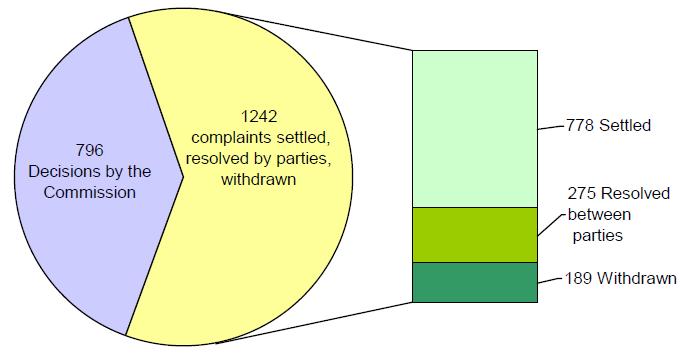
Breakdown of Commission Decisions

Number of complaints citing disability
Financial statement
Financial statement
2003-2004 Actual Year-End Financial Position ($’000)
|
|
2003-04 Printed Estimates |
Revised Budget Mar. 31, 2004 |
Actual Expenditure Mar. 31, 2004 |
2003-04 Year-End Variance |
|
|
|
|
|
|
$ |
% of Revised Budget |
|
Salaries & Wages |
9,132.1 |
9,132.1 |
8,249.6 |
882.5 |
9.7 |
|
Employee Benefits |
969.4 |
969.4 |
990.4 |
(21.0) |
(2.2) |
|
Other Direct Operating Expenses (ODOE) |
2,087.9 |
2,087.9 |
2,742.2 |
(654.3) |
(31.3) |
|
|
12,189.4 |
12,189.4 |
11,982.2 |
207.2 |
1.7 |
Note: The OHRC 2003-2004 year-to-date expenditure of $11,982.8 was decreased by the year-to-date revenues of $0.6, for a net actual expenditure of $11,982.2